
Trace Former Monroe County Owners Backward
Open the CAMA parcel card at its Last Deed entry and work earlier transfers in reverse order. Monroe County publishes no separate online grantor-grantee index, so the routes described here are possibilities rather than guarantees of exact year coverage.
| Source | Years It Covers | Where Held | What It Shows |
|---|---|---|---|
| CAMA deed-history rows | Varies by parcel; one sample reaches 1996 | Public CAMA card | Date and book/page leads, not deed images |
| Recorded deed books/index | Ask Probate; online cutoff unverified | Monroe County Probate | Grantor, grantee and controlling instrument |
| SOS Lands | State-held land records through 1950 | Alabama Secretary of State | Name, township/range/section and book search |
| County microfilm | Runs vary by record type | ADAH catalog and originating office | Older deeds, plats, wills, estates and tax records |
Handle a recent transfer online first. Then shift to Probate deed books, state land records, microfilm and local-history collections as the former-owner chain reaches past what the internet covers.
Monroe Deed History Is a Lead
One parcel card from the Excel area lists dated deed references running from 1996 through 2014. Among them are 829/081, 825/226 flagged ADD REF, 814/358 and earlier rows. That is unusually rich material for rebuilding a list of candidate previous owners. The card still leaves work undone. It never shows a deed's parties, legal text, consideration or exceptions.
The sample CAMA card displays the deed-history context.
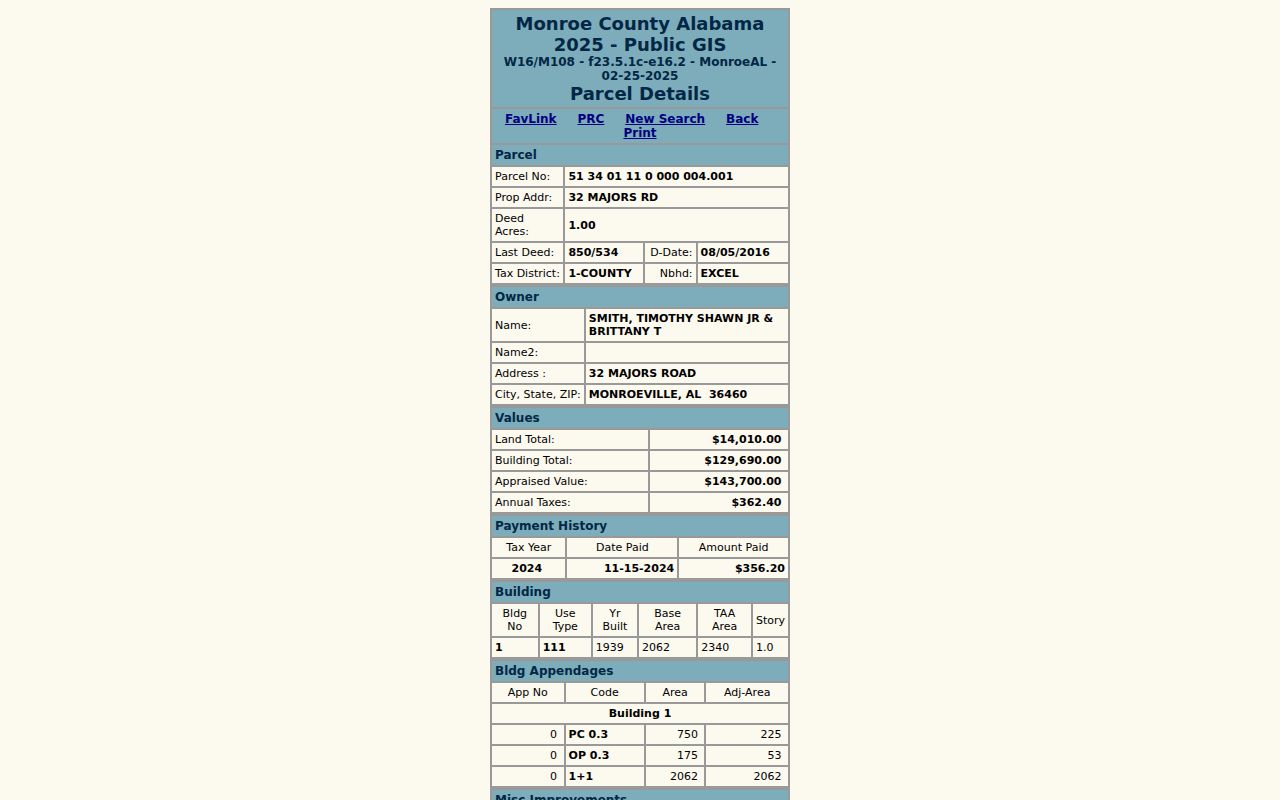
Take every reference to Probate and confirm the parties before it earns a place in the ownership timeline.
Addresses Change, Legal Descriptions Persist
Older deeds often skip modern road wording entirely. Match on lot, block and subdivision. Or use section, township and range. Stay alert for parcel splits along the way. The Frisco entry LOTS 1 2 BLK 6 JW JONES S/D DB74 PG336 anchors the land to a recorded subdivision source. That reference proves far more reliable than a blank physical-address field ever could.
Reconstruct the Monroe County Deed Chain
Build a transfer table from the current deed backward, logging date, parties, deed type and book/page for each move.
| Transfer date | Grantor → grantee | Instrument | Reference |
|---|---|---|---|
| Newest verified date | Prior owner → current owner | Read the deed heading | Book/page from instrument |
| Earlier verified date | Earlier owner → prior owner | Read the deed heading | Book/page from instrument |
- Find the current deed using CAMA's book/page/date as the first lead.
- Read the grantor and exact legal description from that instrument.
- Find the grantor's acquiring deed, where that former owner appeared as grantee.
- Repeat while the legal description remains consistent; continue in deed books or microfilm when online leads end.
- Grantor / grantee
- The conveying and receiving parties named in an instrument.
- Chain of title
- The ordered sequence of recorded transfers affecting the same land.
- Reverse index
- An index used to search by the receiving party and work toward earlier owners.
- Quitclaim / warranty deed
- Different deed forms whose legal effect must be read from the instrument, not inferred from a CAMA row.
Continue Beyond the Unverified Online Cutoff
Monroe County offers no public grantor-grantee portal. Its earliest year and image rules are likewise unlisted online. Call or visit the Probate recording office at 65 N. Alabama Ave., Monroeville, 251-743-4107 Ext. 124. Ask about index access, deed-book years, terminal availability and current copy charges. A written request can specify the book/page, parties, parcel and date range you need.
No invented cutoff. The earliest online year is unknown; older former owners may require physical deed books or microfilm.
Two Courthouse Fires Add a Caution
Monroe County dates to 1815, moved its seat from Claiborne to Monroeville in 1832, and lost courthouses to fires in 1833 and 1928. Those events are good reason to check more than one repository. They do not justify a blanket claim that every deed of an era went up in flames.
Estate Transfers Can Interrupt a Clean Sequence
A death can steer the trail through a will or an administration. It can also route it through a court order, an executor's deed, or heirship evidence. Search the Probate estate file by decedent and case number where that is possible. Then confirm the exact instrument that moved the land. An obituary might hand you a date or an executor's name. It is never proof of title.
Newspapers Bridge Names and Dates
The Monroe County Public Library genealogy room keeps Monroe Journal microfilm reaching back to the 1860s. It also holds cemetery files and family-history material. Legal notices and obituaries can suggest a former owner, an estate or a sale date. Pair every such clue with Probate evidence before trusting it. The ADAH county microfilm catalog opens another historical route.
Historic Plats Stabilize a Former-Owner Chain
A subdivision plat keeps a piece of land identifiable. Owners and street addresses come and go, but the plat holds steady. CAMA exposes labels and legal descriptions. Monroe County posts no current plat-image portal. The exact plat-book run remains unconfirmed. Bring the subdivision name, lot, block, deed reference and parcel number to Probate. For rural land, compare section, township and range against SOS Lands. Excel-Repton and Monvil Park Addition are names worth chasing. Neither becomes a confirmed historic plat without recorded evidence behind it.
Document a Gap Instead of Guessing
When the acquiring deed will not surface, write down the last verified instrument, the exact legal description, the name variants searched and the missing interval. Then sweep estates, court matters, plats, tax rolls, newspapers and microfilm. A quiet-title or partition case may explain a strange transfer, and an executor's deed can tie an estate to its next grantee. Court evidence supplements the recorded chain. It never licenses an invented link.
State and Local Historic Routes
The Alabama SOS Lands portal searches older state-held records by name, township/range/section and book through 1950. It cannot replace Monroe Probate, though. ADAH microfilm offers another bridge, with runs that vary by record type. The library's Monroe Journal microfilm can pin down dates before a deed-book search begins. Every clue must lead back to the parcel's legal description.
Preserve the Transfer Evidence
For each former owner, save the date, grantor, grantee, deed type, full book/page, legal description and any correction reference. Keep confirmed deeds apart from CAMA leads, newspaper clues and family-history notes. That discipline stops a plausible name from slipping quietly into the recorded chain, and it keeps later gaps visible.
Depth of Monroe County Ownership Records
No single universal start year governs Monroe County deeds. Probate stands as the first custodian. SOS Lands bridges older state-held records through 1950. ADAH reports that most originals stay with the originating office. Microfilm runs vary by type. For a stubborn chain, log every repository checked and every gap rather than silently joining names.
Parcel changes can also break a trail that looked continuous. When acreage, lot description or parcel number shifts, hunt for a split, a combination, a corrective instrument or a new plat. Go on only once the old and new descriptions reconcile. The street address is supporting context, never the durable key to a long historical chain.
Lawful use. Former-owner research supports house history, estate work and property diligence. Never use it to track, stalk, harass or harm a living person.
Monroe Newspaper Notices Add Leads
The Monroe County Public Library keeps newspaper microfilm going back to the 1860s. That long run of local papers is a quiet goldmine for property records research. Estate notices, obituaries, land-sale advertisements, and legal notices can surface a prior owner of record or flag a transfer the deed records seem to skip.
Note: save the issue and page number, then confirm the name and legal description in a deed or probate file.
Parcel Splits Complicate Prior Owners
Today's tax parcel has not always looked the way it does now. A single parcel may have been carved from a larger tract. Several older lots may have been merged into one. Working backward through Monroe County property records means following the legal description, the acreage, and the adjoining calls. It also means following any prior deed a document references. A recorded plat often shows exactly when and how the tract changed shape.