
Fields in Monroe County Tax Records
The public CAMA card blends appraisal components with selected tax history. Appraised value never equals assessed value. Read each figure by its label before trusting it, since an annual tax entry is not a live payoff quote.
| Field | What It Shows | Where |
|---|---|---|
| Land value | Appraised land component | CAMA card |
| Building value | Appraised structure component | CAMA card |
| Appraised value | Combined appraisal | CAMA card |
| Annual tax | Displayed annual charge | CAMA card |
| Payment history | Year, date, and amount when present | CAMA card |
| District | County or municipal tax area | CAMA card |
A tax record proves no sale price. It is the assessment trail behind a parcel, useful for asking sharper questions about title, survey lines, and the amount due today.
How Alabama Assesses Monroe Property
Alabama measures fair market value first. A constitutional class ratio converts that into assessed value. Millage is applied after exemptions. Class II property is generally assessed at 20 percent, Class III at 10, Class IV at 15, and centrally assessed Class I at 30. A mill simply means one dollar of tax per thousand dollars of assessed value. County, school, and city levies can change the bill, so use the parcel's actual class and district rather than a sample rate.
- Appraised value
- The assessor's estimate of full value.
- Assessed value
- The class-adjusted tax base before exemptions.
- Millage
- Tax dollars per thousand dollars assessed.
- Tax lien
- A claim arising from unpaid property tax.
Search Monroe Property Tax Fields
The Monroe CAMA form accepts parcel, owner, location, mailing address, acreage and value ranges, subdivision, district, deed book and page, deed date, and section-township-range. Location marks the site, not the tax mailing address.
| Field | Tax use | Caution |
|---|---|---|
| Parcel No | Exact assessment | Copy each segment |
| Location | Street lookup | May be blank |
| Owner's Name | Find roll entries | Partial match |
| TL Value | Value range | Not sale price |
| District | Tax area | Postal city may differ |
No login or payment gate was observed.
Alabama's 7 Percent Value Cap
Act 2024-344 caps year-to-year growth at 7 percent for qualifying Class II and III taxable assessed value. An ownership change can trigger reassessment. The cap covers taxable assessed value. Compare current and prior roll fields. Before treating a rise as an error, check class, ownership, exemptions, and statutory base, and ask Revenue how the act applied to the parcel.
Look Up Monroe County Property Tax
CAMA is the public route here. Monroe County publishes no separate online bill, so treat annual tax and payment rows as roll history rather than a live collector statement.
- Search CAMA by address, owner, or parcel.
- Note district, value components, annual tax, and payment rows.
- Confirm exemptions and taxable assessed value with Revenue.
- Request a current bill or payoff from the county office.
- Check state delinquent-land sources when needed.
- Homestead exemption
- Relief that may reduce tax for an eligible owner-occupied home.
- Payment history
- A displayed payment, not proof that nothing is now due.
Monroe CAMA Values in Context
The Monroeville property card shows the combined layout of values. Sample cards display land, building, and total appraisal alongside annual tax and prior payments. One Excel-area tract carries positive land value. It has zero building value and a small annual tax. Totals alone cannot compare the two.
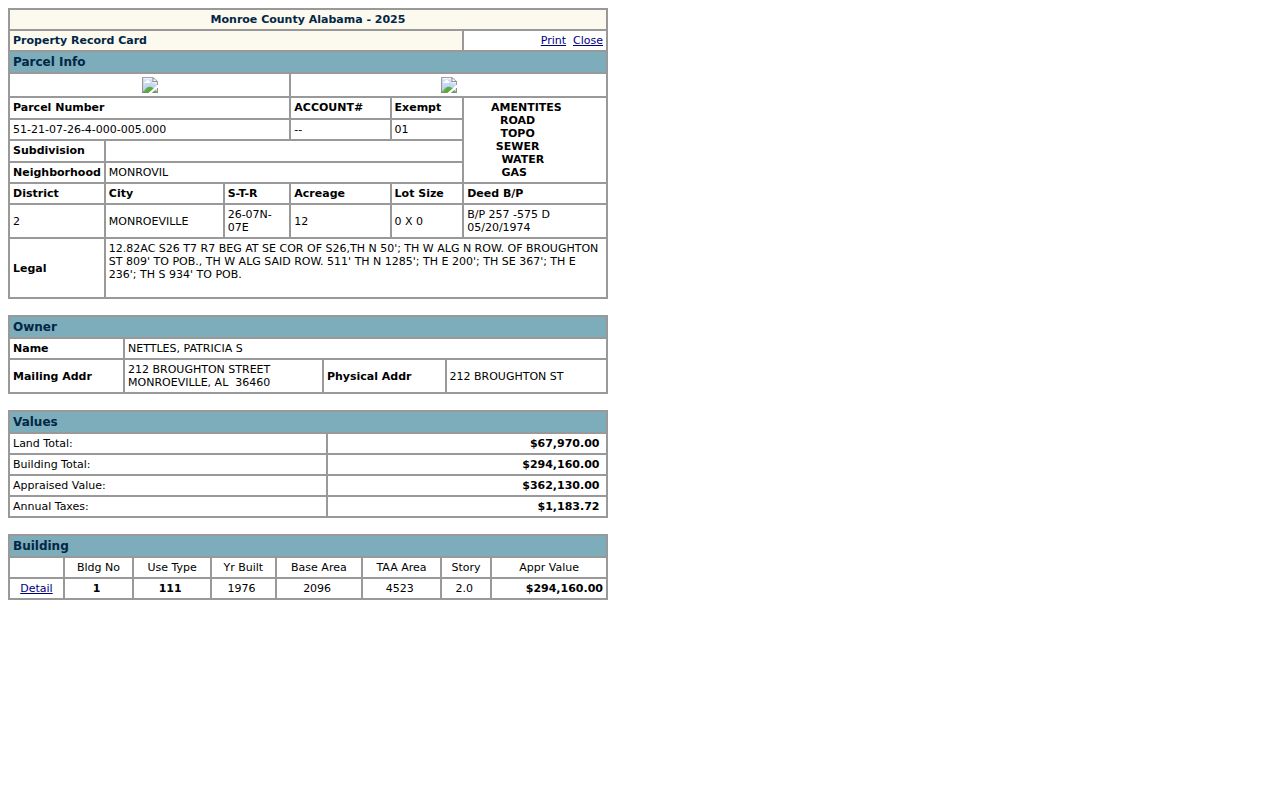
The view joins everything without becoming a certified bill.
Monroe County Tax District Choices
The portal lists County, Monroeville, Frisco City, Beatrice, Excel, and Vredenburgh districts. Postal names never settle municipal limits. One Excel-neighborhood sample sits in District 1 County. It is not District 5 Excel, so use the district on the parcel and compare GIS or ask staff when annexation affects a levy.
Delinquent Monroe Property Tax Records
The Alabama delinquent-property page explains county sale and Book of Lands routes.

Delinquency is not the same as a sale. State sources help separate a delinquent parcel from its sale and later land records, and a certificate or Book of Lands entry is never instant clear title because redemption may apply.
Contest a Monroe County Assessment
State guidance routes an owner from notice review to the county Board of Equalization. Contact the Revenue Commissioner when a notice arrives. Ask for the deadline, filing method, and evidence rules. Useful evidence includes a corrected description, condition photos, a qualified appraisal, and well-matched sales. Keep proof of timely filing.
Confirm the window. No current Monroe appeal date was verified. Ask Revenue and the Board of Equalization before relying on a general schedule.
Monroe Exemptions Change the Tax Base
Homestead and other lawful exemptions shrink the taxable base only when the parcel and owner qualify under Alabama rules. They rewrite no deed and set no sale price. Read the CAMA card whole. Class, appraised value, assessed value, exemption fields, district, and annual tax belong together. A low annual amount can reflect a land-only parcel, an exemption, classification, millage, or several factors at once. That single number hides more than it reveals on its own. Ask the Monroe County Revenue Commissioner which application, proof, and filing period fit the parcel. Statewide descriptions rarely carry the local deadline. Preserve any notice you receive. Request written confirmation when it looks wrong.
Appeal a Monroe Assessment Carefully
An assessment appeal challenges the county's valuation or classification, never the deed's language. Start with the property card and the notice. Check parcel identity, acreage, land and building components, class, exemptions, district, and structure facts. Look for ownership changes too. Those can affect seven-percent cap treatment. Gather dated photographs, measurements, comparable sales, or correction documents that speak to the disputed field. Contact Revenue for the current board route and deadline. The county posts no reliable local calendar, so quoting a general state page will not repair a missed deadline. Keep proof of submission. Ask when the board will act, and obtain the written result before weighing later review.
An assessment record and proof of payment are two different things. The CAMA payment-history line helps, but it is not a certified tax statement. Never work backward from annual tax, appraised value, or deed date to a market sale price. A closing, redemption question, or appeal can turn on exact figures. Ask Revenue for the current balance, delinquency status, payment receipt, and any pending correction. Write down the date of that confirmation. Tax status can shift after the public card was last viewed.
Recorded consideration and transfer evidence live with the deed. An independent appraisal answers a separate valuation question. On older or disputed entries, ask which roll year controls. Also ask whether the county can provide a dated copy or certification. Keep dated proof of each result.