
What Monroe County Deed Records Hold
The Monroe County Probate Judge records deeds. The office also takes in every other instrument affecting title. A thorough search reaches beyond deeds alone. It pulls in mortgages, liens, judgments, releases, and subdivision plats. Each recorded instrument names the parties. It also describes the land, states its form, and fixes the date it entered the public record. Together these documents are the backbone of Monroe County property records.
| Deed Type | What It Does | Common Use |
|---|---|---|
| Warranty deed | Conveys land with stated covenants | Ordinary sale |
| Quitclaim deed | Conveys only an existing interest | Family or title cleanup |
| Mortgage | Records a security interest | Financed purchase |
| Release | Discharges a recorded claim | Clearing a paid lien |
| Plat | Records subdivision layout | Lot and block reference |
A deed transfers an interest in land. A mortgage or lien burdens it instead. Both land in the same recording system, which is why a deed-only search never amounts to a full encumbrance check.
Where Monroe County Deeds Are Recorded
Deeds are recorded at the Monroe County Probate Judge / Revenue Commissioner office, 65 N. Alabama Avenue, Monroeville. Call 251-743-4107 Ext. 124 before visiting. Staff can confirm public-terminal access, hours, book coverage, and current copy charges. The county posts scanned 2012 fee sheets online. Today's amounts may differ, so ask for a quote.
Act 2012-494 lets Monroe County keep computer, optical-disk, or paper files as official records once the systems are installed. The act also permits discretionary special recording and transaction charges. Those permissions set no fixed price. Request an estimate, and distinguish plain copies from certified ones.
CAMA Deed History Is a Lead
The Monroe CAMA portal takes deed book/page and date criteria. Its cards display Last Deed, D-Date, and prior references. The cards stop short of deed images, though. They also show no consideration, certification, or full party roles.
Write down the parcel number, book/page, and date before calling Probate. A CAMA row points you toward Monroe County deed records. It is a lead, not a substitute.
See Monroe Deed-History Clues
An Excel-area parcel card shows several dated references beside assessment fields.
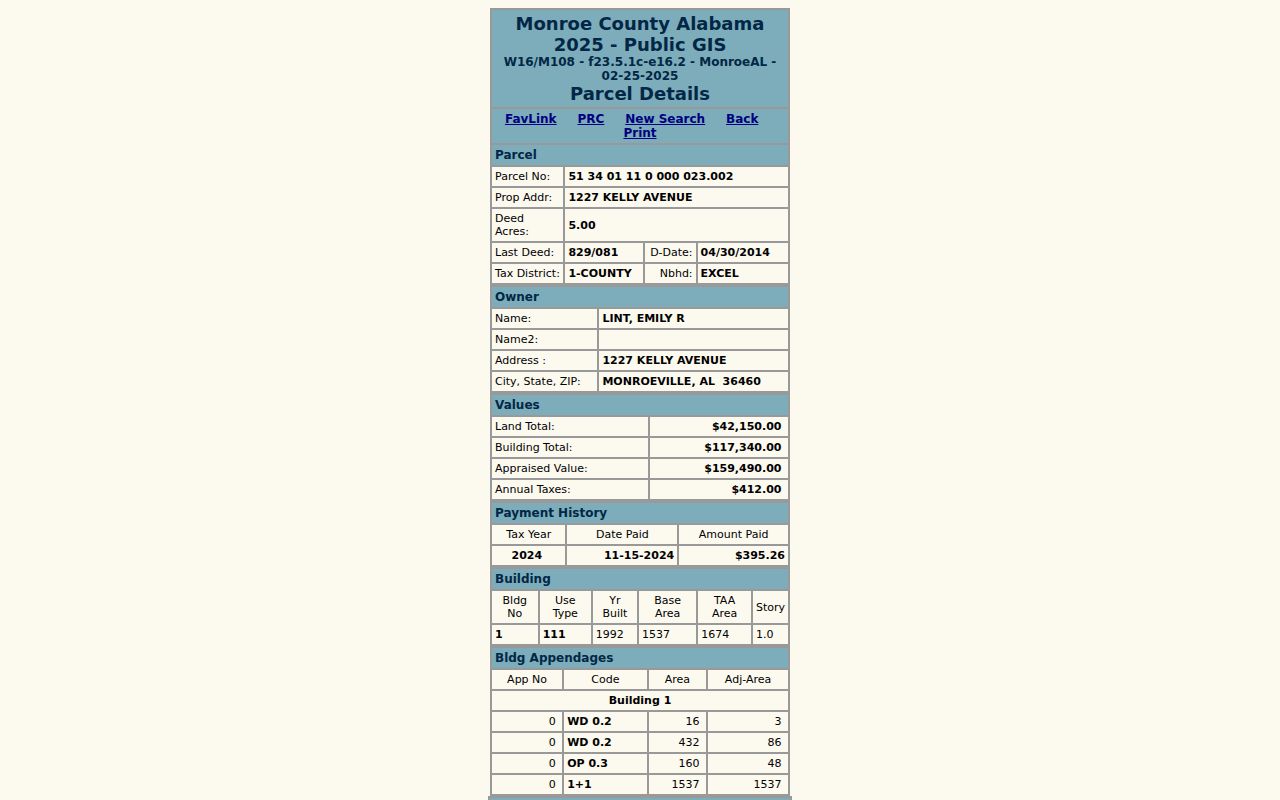
The rows make a practical request list, but each underlying deed still needs inspection.
Monroe County Grantor-Grantee Research
Monroe County publishes no separate online grantor-grantee index. A grantor conveys an interest in real property. A grantee receives it. Because the same name often appears on both sides of Monroe County property transfers across different deeds, a thorough property search should cover each role.
- Start with the current roll owner and last deed reference.
- Find the deed where that owner is grantee.
- Record the prior grantor, description, date, and book/page.
- Search that grantor as an earlier grantee and repeat.
- Grantor
- The party conveying an interest.
- Grantee
- The party receiving it.
- Chain of title
- The ordered sequence of transfers for the same land.
- Book/Page
- The reference visible in Monroe CAMA; no public instrument-number convention was confirmed.
Recordation Tax and Monroe Deeds
Alabama charges a deed recordation tax of $0.50 per $500 of value or fraction. Mortgage tax runs $0.15 per $100 of debt. The probate judge collects both when a deed is recorded. These amounts are taxes on the transaction. They are not copy fees or proof of what a property sold for.
Sample cards in the deed records show no consideration. Read the deed itself. Guessing a sale price from the appraisal, the annual tax bill, or a reference row invites error.
Older Monroe County Deed Records
Monroe County sets no official online cutoff for its recorder. The Alabama SOS Lands office holds state-level records from statehood through 1950. Search by name, township/range/section, or deed book. Treat it as a historical bridge. It is not the current source for Monroe County deed records.
The ADAH county microfilm search lists record types with year runs that vary. The Monroe County Public Library genealogy room holds newspapers, cemetery files, and family histories. Those materials often surface estate or land notices that point back to a parcel.
Monroe Courthouse Fires Need Verification
County histories report fires at Claiborne in 1833 and Monroeville in 1928. Neither event proves every old deed vanished. Ask Probate and ADAH which deed books survive. Ask which were recopied. Ask whether an index was rebuilt.
Newspaper notices, estate files, federal land sources, and adjoining deeds can bridge a gap. Tie every lead back to a surviving legal description or plat before trusting it.
Request a Monroe County Deed Copy
A written request to Probate works best when it is specific. Include party names, the deed date, book and page. Also give the parcel number and any legal-description clues. Ask staff about inspection options, a public terminal, phone assistance, or mail service. Say whether you want a plain or certified copy, and request a fee quote. A narrow request can also cite Ala. Code § 36-12-40.
Missing a reference? Start with the Monroe County property search to find the deed record first. Older Monroe County property records may require books, microfilm, SOS Lands, the library, or ADAH instead.
Recorded, not guaranteed. Monroe County deed records show what reached the books. Unrecorded interests may exist, so one deed is not a title opinion.
Monroe Deeds and Estate Transfers
A death certificate proves that a Monroe County owner died, but it moves no dirt. Transferring the land takes a deed record. The probate file usually tells the fuller story: a will, letters of administration, an inventory, and sale orders. It also proves who holds fiduciary authority over the estate.
Start with the owner of record on the tax roll. Pull the last deed reference under that name. Then ask the Probate Judge for the estate file. Ask also for any executor, administrator, personal-representative, corrective, or heir deed tied to the parcel's legal description. Copy the grantor and grantee exactly as written. When a court approved a sale, lay the order's property exhibit beside the recorded conveyance. The two should match, and the estate caption alone is not enough to prove it.
Recorded Liens Need Release Checks
A Monroe County chain of title is more than a list of deeds. Mortgages, assignments, and satisfactions can burden or clear the land. Judgment certificates, mechanic's liens, easements, restrictions, and plats can do the same. Treat releases as their own records. The CAMA deed-history rows were never built as an encumbrance index. So calling them a lien search overstates what they do.
Ask Probate how the public terminals index each class of instrument. A name may work best for one document. A book and page or legal description may work better for another. Judgments travel, too. A Monroe civil judgment can start at the Circuit Clerk. It can resurface later as a recorded certificate or satisfaction. Check both ends of that handoff. For a purchase, loan, or boundary dispute, professional title work is still the safer route.
When you request an instrument from the recorder, be specific about what you need. Say whether you want a deed, mortgage, release, lien, easement, plat, or probate conveyance. Give both party names if you know them. Add a narrow date range, the parcel number, the legal description, and any book and page lead you have. Ask up front whether you can inspect the record before ordering copies. Also ask whether certification costs extra. Monroe County's scanned fee sheets are dated. No single current price list is published, so confirming costs in advance saves surprises.
Keep the full identity of any instrument you obtain. That means the recording stamp, book and page, execution date, recording date, party roles, legal description, and any prior instrument the document references. With those details in hand, you can verify the next link in the Monroe County property records chain. You will not need to lean on an address that may have changed over the years.
If a referenced instrument is not online, ask about other routes. The courthouse may offer a public terminal, staff-assisted retrieval, mail service, or fax delivery. You can also file an Alabama Open Records Law request.